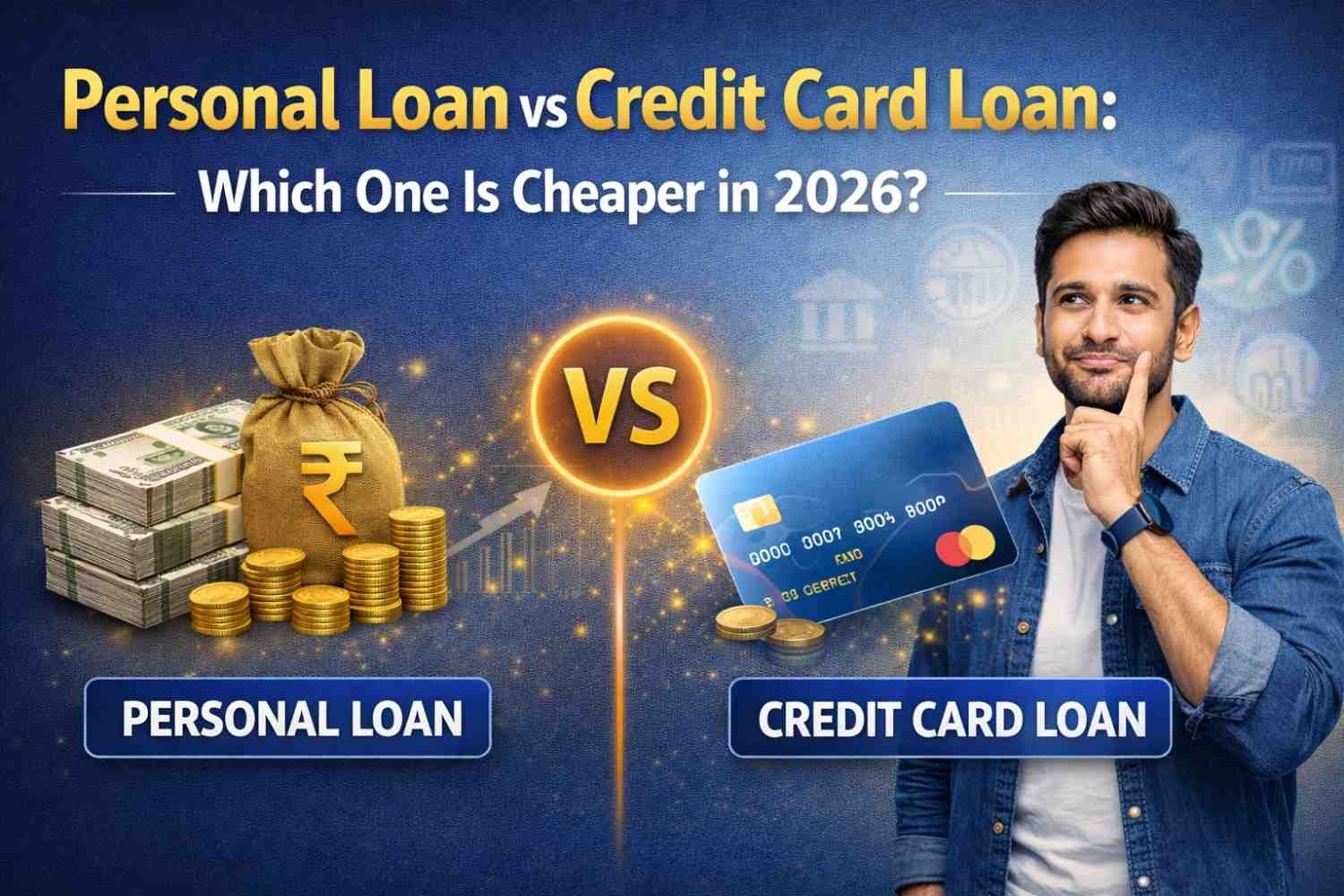
When people need quick money for emergencies, travel, education, or other expenses, they often consider borrowing options like personal loans or credit card loans. Both options provide access to funds, but they work in different ways and come with different interest rates, repayment terms, and eligibility conditions.
Many borrowers get confused when deciding between a personal loan vs credit card loan. Choosing the wrong option can increase your interest burden or make repayment difficult.
In this guide, we will explain the key differences between personal loans and credit card loans, which option usually has lower interest, when it makes sense to choose a credit card loan, and how EMI comparisons can help you make a better decision.
What Is a Personal Loan?
A personal loan is an unsecured loan offered by banks, NBFCs, or digital lenders. It does not require any collateral such as property or gold. The lender approves the loan based on factors like your income, employment status, and credit score.
Once the loan is approved, the entire loan amount is transferred directly to your bank account. You then repay the amount in fixed monthly installments (EMIs) over a specific period.
Key Features of Personal Loans
-
No collateral required
-
Fixed interest rates in many cases
-
Flexible repayment tenure
-
Loan amounts can be higher
Personal loans are commonly used for expenses like medical emergencies, weddings, home renovation, travel, or education.
What Is a Credit Card Loan?
A credit card loan is a loan facility offered to existing credit card holders. Instead of applying for a separate loan, the bank allows you to convert your available credit limit into a loan.
The loan amount is either transferred to your bank account or converted into EMIs on your credit card statement.
Key Features of Credit Card Loans
-
Available only to credit card users
-
Quick approval process
-
No additional documentation in many cases
-
Flexible EMI options
Credit card loans are often used for short-term financial needs because they are easy to access.
Personal Loan vs Credit Card Loan: Key Differences
Although both options provide quick access to funds, they differ in several important ways.
1. Loan Amount
Personal loans usually offer higher loan amounts compared to credit card loans.
A personal loan may range from ₹50,000 to ₹20 lakh or more, depending on your income and credit score.
On the other hand, a credit card loan is limited by your available credit limit. If your credit card limit is ₹1,00,000, you cannot borrow more than that amount.
2. Interest Rates
Interest rates are one of the biggest differences between personal loans and credit card loans.
Personal loan interest rates generally range between 10% and 18% per year, depending on the lender and your credit profile.
Credit card loans usually have higher interest rates because they are considered short-term borrowing options.
This means that for larger loan amounts or longer tenures, personal loans are often the cheaper option.
3. Approval Process
Personal loans usually require a formal application process. The lender may check your income proof, employment details, and credit score before approving the loan.
Credit card loans, however, are often pre-approved for existing cardholders. If you already have a credit card with a good repayment history, the bank may offer a loan instantly through mobile banking or internet banking.
This makes credit card loans faster and easier to access.
4. Repayment Tenure
Personal loans typically offer longer repayment periods. Depending on the lender, you may get a tenure ranging from 1 year to 5 years or more.
Credit card loans usually come with shorter repayment tenures, often ranging from 3 months to 24 months.
Shorter tenures may result in higher monthly EMIs.
5. Documentation
Personal loans may require documents such as:
-
PAN card
-
Aadhaar card
-
Salary slips
-
Bank statements
Credit card loans usually require minimal documentation because the bank already has your details if you are an existing cardholder.
Which Loan Has Lower Interest?
In most cases, personal loans have lower interest rates compared to credit card loans.
Banks consider personal loans slightly less risky because borrowers go through a formal verification process before approval.
Credit card loans are designed for convenience and quick access, which is why they often come with higher interest rates.
However, interest rates can vary depending on:
-
Your credit score
-
Your income level
-
The lender’s policies
Borrowers with a strong credit history may receive better interest rates for both loan types.
When Should You Choose a Credit Card Loan?
Although credit card loans may have higher interest rates, they can still be useful in certain situations.
1. When You Need Money Quickly
Credit card loans are often available instantly through mobile banking apps. If you need funds urgently, this option may be faster than applying for a personal loan.
2. When the Loan Amount Is Small
For smaller amounts, the difference in interest may not be significant. In such cases, a credit card loan can be convenient.
3. When You Already Have a Pre-Approved Offer
Banks frequently provide pre-approved credit card loan offers to loyal customers. These offers may come with competitive interest rates.
EMI Comparison: Personal Loan vs Credit Card Loan
Before choosing between these options, it is important to compare the EMI and total interest cost.
For example:
If you borrow ₹1,00,000 for 2 years:
-
A personal loan with a 12% interest rate may result in a lower EMI and lower total interest.
-
A credit card loan with a higher interest rate may increase your monthly EMI and total repayment amount.
Using an online EMI calculator can help you compare different loan options and choose the one that fits your budget.
Factors to Consider Before Choosing a Loan
Before selecting a loan option, consider the following factors carefully.
Interest Rate
Lower interest rates reduce your overall borrowing cost.
Loan Amount
Choose a loan that meets your financial requirement without exceeding your repayment capacity.
Processing Fees
Some lenders charge processing fees or service charges.
Repayment Flexibility
Longer repayment tenures can make EMIs more manageable.
Smart Borrowing Tips
Borrowing money should always be done responsibly.
Here are a few tips to keep in mind:
-
Borrow only the amount you actually need
-
Compare multiple lenders before choosing a loan
-
Check interest rates and additional charges
-
Make EMI payments on time
Timely repayment not only avoids penalties but also helps improve your credit score.
Final Thoughts
Both personal loans and credit card loans are useful financial tools, but they serve different purposes. Personal loans are generally better for larger expenses and longer repayment periods because they often have lower interest rates.
Credit card loans, on the other hand, are more suitable for smaller and urgent financial needs due to their quick approval process.
Before choosing between a personal loan vs credit card loan, it is important to compare interest rates, EMI amounts, repayment tenure, and overall borrowing cost.
Making an informed decision will help you manage your finances better and avoid unnecessary financial stress.